Apex grew around a railroad station, was incorporated in 1873 and named for the high point on the Chatham Railroad. Its historic district and landmarks, with dates.
Last checked Oct. 11, 2026. History on this page comes from the Town of Apex’s history page and historic district page, the Apex Historical Society, and National Register listing dates from the National Park Service’s NPGallery database. This page is updated when new listings or markers are added.
Apex began as a stop on a railroad. Its station was chartered in 1854, the first train came through in 1869, settlers arrived in the 1860s and the town was incorporated in 1873, according to the town. The Apex Historical Society says the place was once called “Log Pond.”
Visit and ask
- Apex Historical Society: apexhistoricalsociety.com; ask it about walking tours of downtown
- The Halle Cultural Arts Center (1912 Town Hall): 237 N. Salem St., 919-249-1120, 9 a.m. to 6 p.m. weekdays and 9 a.m. to 1 p.m. Saturday
- Town historic preservation and planning: 919-249-3426
- Town records from the 1800s on, by appointment: Town Clerk, 919-249-1260
Why “Apex”
The town sits at the highest point along a 30-mile stretch of the old Chatham Railroad, the town says, and steam engines stopped at the top of the climb to take on water on the way to Raleigh. The town gives a second reason for the name: rain that falls on one side of Salem Street drains to the Neuse River, and rain on the other side to the Cape Fear.
How the town grew
- Turpentine and timber. The station stood in a large pine forest, so early Apex shipped lumber, tar and turpentine. By 1900 the town had 349 people.
- Tobacco. In the early 1900s, tobacco farmers from Person and Granville counties moved to the area after a plant disease hit their crops. The first tobacco auction market in Wake County opened in Apex in 1905.
- Two fires. A fire in February 1905 destroyed several frame stores, and another on June 12, 1911, burned much of the business district, including the Merchants and Farmers Bank. Merchants rebuilt in brick. By 1913 the 100 block of Salem Street had pressed-brick storefronts, and the Union Depot was rebuilt in 1914.
- Boom and bust. The town reached 1,000 people by 1920, then fell to 863 by 1930 as the tobacco market declined. By 1934 trains were making only four stops at the Apex depot, the town says.
- The Research Triangle. Apex stayed small until Research Triangle Park opened nearby in the early 1960s. The population reached about 5,000 by 1990, and grew fast after that; the Census Bureau now estimates more than 80,000 (see our population guide).
The historic district
Downtown Apex and the neighborhoods around it form the Apex Historic District, which the town calls one of the best examples of an intact turn-of-the-century railroad town in North Carolina. Buildings date to the late 1800s in a wide range of styles. Since 2006 a Small Town Character Overlay District has set design rules for new building around it; see our permits and zoning guide.
National Register of Historic Places listings
Dates are the listing dates in the National Park Service database.
| Property | Location | Listed | Notes |
|---|---|---|---|
| Apex Town Hall (listed as Apex City Hall), now the Halle Cultural Arts Center | 237 N. Salem St. | Dec. 5, 1985 | Built 1912 |
| Apex Union Depot | Southeast corner of North Salem and Center streets | Dec. 1, 1988 | Rebuilt 1914 |
| Apex Historic District | Downtown, roughly North Elm, North Salem, Center, South Salem and West Chatham streets | March 17, 1994 | |
| Apex Historic District boundary increase | Roughly East Chatham, South Hughes, South Mason and East Moore streets | March 10, 1995 | |
| Apex Historic District boundary increase | Downtown | Feb. 14, 2002 | |
| Apex Historic District boundary increase II | Downtown | Jan. 31, 2008 | |
| Utley-Council House | Rural Wake County near Apex | May 16, 2002 | Significant date 1820; private home |
| Calvin Wray Lawrence House | Apex area | Sept. 23, 2008 | Significant date 1880; private home |
| Samuel Bartley Holleman House | New Hill | Jan. 30, 2008 | Significant date 1913; private home |
| New Hill Historic District | New Hill, southwest of Apex | April 25, 2001 | Significant date 1860 |
The private homes on this list are not open to the public; view them from the road. The town publishes a map of the National Register district and individually listed properties (PDF) and a state inventory map for Apex and New Hill (PDF).
Places you can visit
The Halle Cultural Arts Center, 237 N. Salem St. The 1912 Town Hall once held a farmers market, a firehouse and two jail cells downstairs, and the mayor’s office and an opera-style theater upstairs, according to the town. It is now an arts center with galleries and a theater, open 9 a.m. to 6 p.m. weekdays and 9 a.m. to 1 p.m. Saturday.
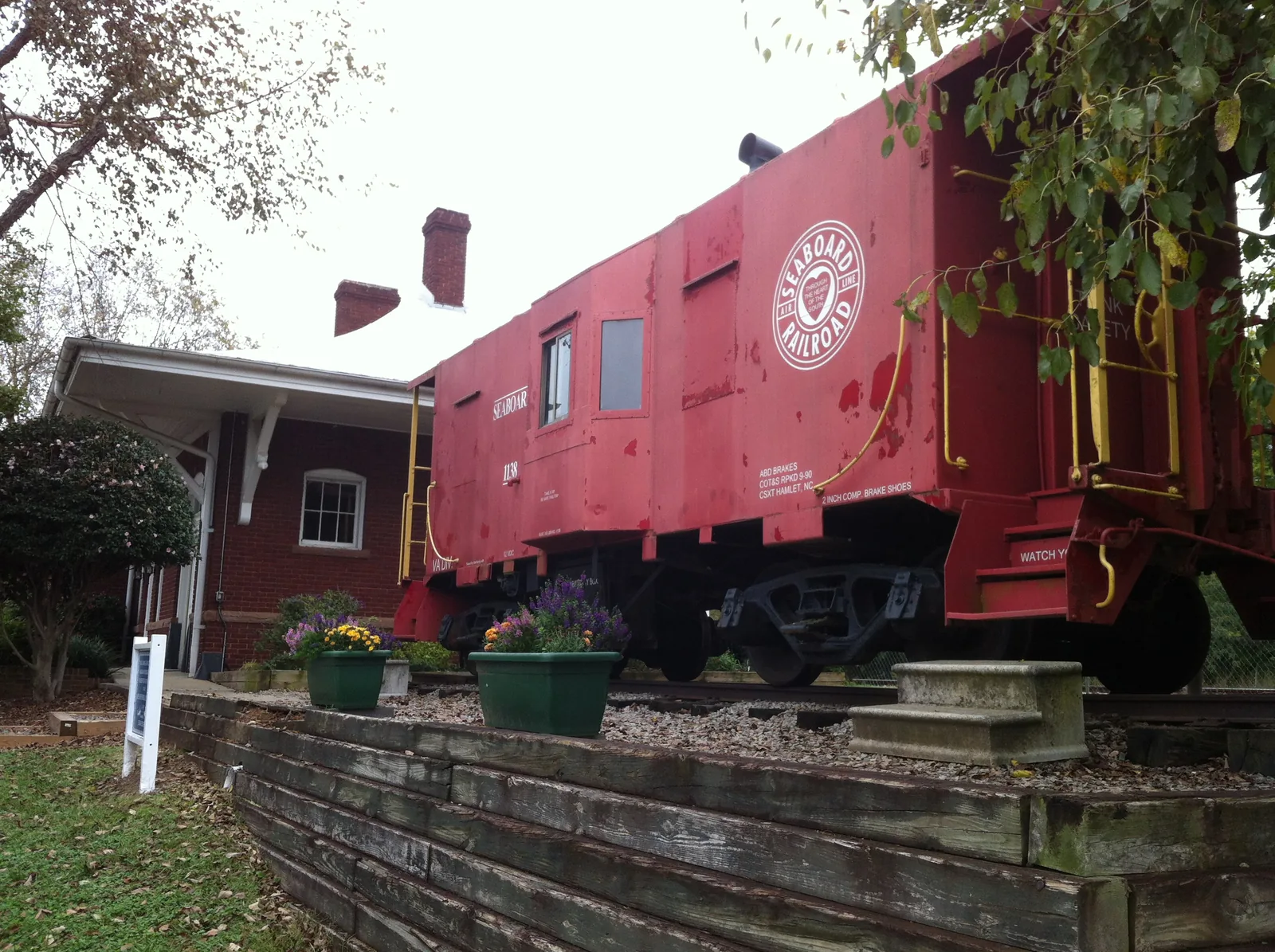
The Depot and caboose, 220 N. Salem St. The town says the depot was built sometime between 1867 and 1873, marked the highest point on the old Chatham Railroad and is a Wake County landmark. A caboose beside it serves as a small historical museum. The depot houses the Apex Welcome Center, open 8:30 a.m. to 5 p.m. weekdays, and the Apex Chamber of Commerce.
Apex Cemetery, Upchurch Street at West Moore Street. Town-owned; open to visitors 7 a.m. to sunset April 1 to Oct. 31 and 8 a.m. to 5 p.m. Nov. 1 to March 31 (town cemetery page).
Online tours. The town’s story maps cover the history of Apex, its Wake County landmark properties and the surrounding communities of Fairview, Friendship, Green Level, Low End, New Hill, Olive Chapel and Whops.
Historical markers
The town runs a historical marker program; groups and owners can apply with the town’s marker application (PDF).
Frequently asked questions
How did Apex, NC, get its name?
The town says it sits at the highest point along a 30-mile stretch of the old Chatham Railroad, where steam engines stopped to take on water after the climb, hence the name Apex.
When was Apex incorporated?
Apex was incorporated in 1873. Its railroad station was chartered in 1854, but the first train did not pass through until 1869.
What is the Apex Historic District?
Downtown Apex and the neighborhoods around it, listed on the National Register of Historic Places on March 17, 1994, with boundary increases in 1995, 2002 and 2008. The town calls it one of the best examples of an intact turn-of-the-century railroad town in North Carolina.
What was Apex called before it was Apex?
The Apex Historical Society says the town was once called Log Pond.
What is the Halle Cultural Arts Center?
Apex’s 1912 Town Hall at 237 N. Salem St., listed on the National Register in 1985 and now a town arts center open weekdays and Saturday mornings.
Have your say